Testing HubSpot missing-scope 403s with FetchSandbox
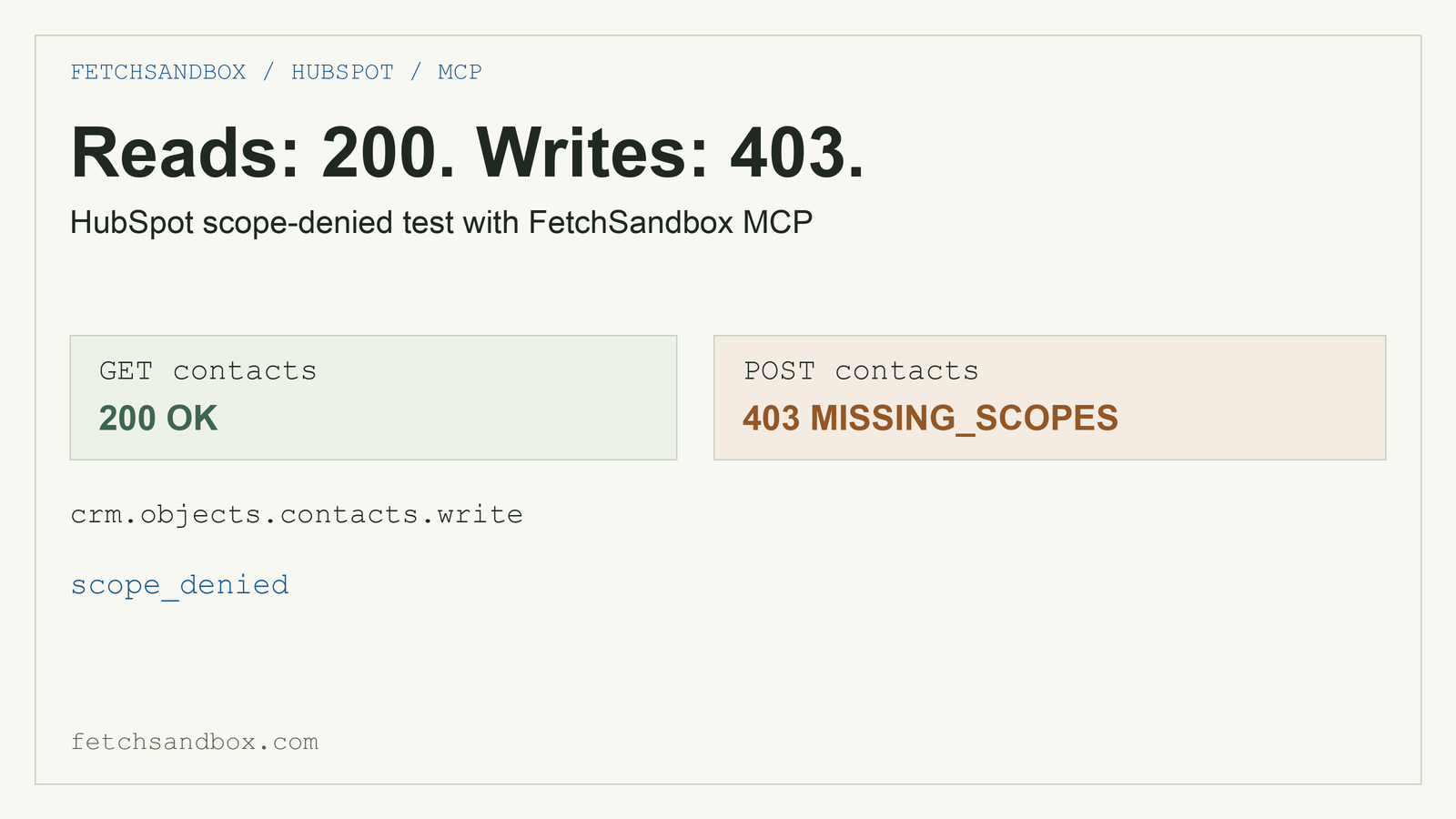
The connection works. Contact reads work. Then the first write gets denied.
That is the failure mode worth catching before it reaches a production CRM. If your app calls POST /crm/v3/objects/contacts and the OAuth token covers read scope but not write scope, HubSpot returns a 403 with category MISSING_SCOPES. The error itself is unambiguous. The question is whether your app handles it correctly and does not silently mark the contact as synced.
What the provider-side test showed
On October 13 I spun up a fresh HubSpot twin on FetchSandbox under the scope_denied scenario. That scenario sets auth_enabled to true and denies crm.objects.contacts.write. Both requests used the same synthetic credential. No application was attached. The twin was deleted after the test.
| Method | Path | Status |
|---|---|---|
| GET | /crm/v3/objects/contacts |
200 |
| POST | /crm/v3/objects/contacts |
403 |
The 403 response:
{
  "status": "error",
  "message": "token lacks required scope(s): crm.objects.contacts.write",
  "category": "MISSING_SCOPES",
  "errors": [{"context": {"requiredGranularScopes": ["crm.objects.contacts.write"]}}]
}
This confirms the provider-shaped negative path. Because no app was attached, retry counts, refresh counts, and local record state were not measured. Those are application observations and have to be tested separately.
What your app still needs to prove
MISSING_SCOPES is not a transient error. The token is valid, just under-scoped, so retrying or attempting a token refresh accomplishes nothing. If your app does either, that is a bug. An important failure to catch is reporting a denied write as synced.
Whether to hold a local pending record until the scope is corrected is your team's design call. Some apps do this intentionally.
Not every 403 from HubSpot means the same thing. This is specifically about MISSING_SCOPES. Other 403 subtypes have different semantics. HubSpot's documentation on read and write scopes covers the distinction.
Running this with the MCP
Point your agent at fetchsandbox.com/mcp. Ask it to discover the HubSpot scope_denied scenario, exercise your app against the twin, record the denied POST /crm/v3/objects/contacts request, and observe what the app does. Once the local observation passes, retain those assertions in your CI pipeline to catch regressions before they ship.
This is one example of checking critical behavior across a system boundary, not a claim about any particular tool's scope. More context on testing auth without real credentials: fetchsandbox.com/blog/testing-api-auth-without-real-credentials.
Final real OAuth consent still requires a provider test. This run measured provider denial only; no app was attached, so it did not verify application handling.